
By the Serenus Outpatient Detox Care Team · Medically reviewed content · 6 min read
If you’re weighing detox options for yourself or someone you love, you’ve probably run into the same fork in the road: do you check into a facility, or do you find a program you can attend while keeping your life intact? Choosing between outpatient detox and inpatient detox is one of the first real decisions in recovery — and it matters more than most people realize.
Here’s the good news. There isn’t a single “better” option. There’s a better option for your situation. This guide breaks down the real differences, who each setting fits, and a simple way to think it through.
What’s the Real Difference Between Inpatient and Outpatient Detox?
The core difference is where you sleep. Inpatient (or residential) detox means you live at a facility for the length of your withdrawal, usually several days to two weeks. Outpatient detox means you come in for scheduled, medically supervised visits and go home at the end of each one.
But the practical differences run deeper than the overnight stay. They touch your work, your family, your privacy, and how the rest of your life keeps running while you get well.
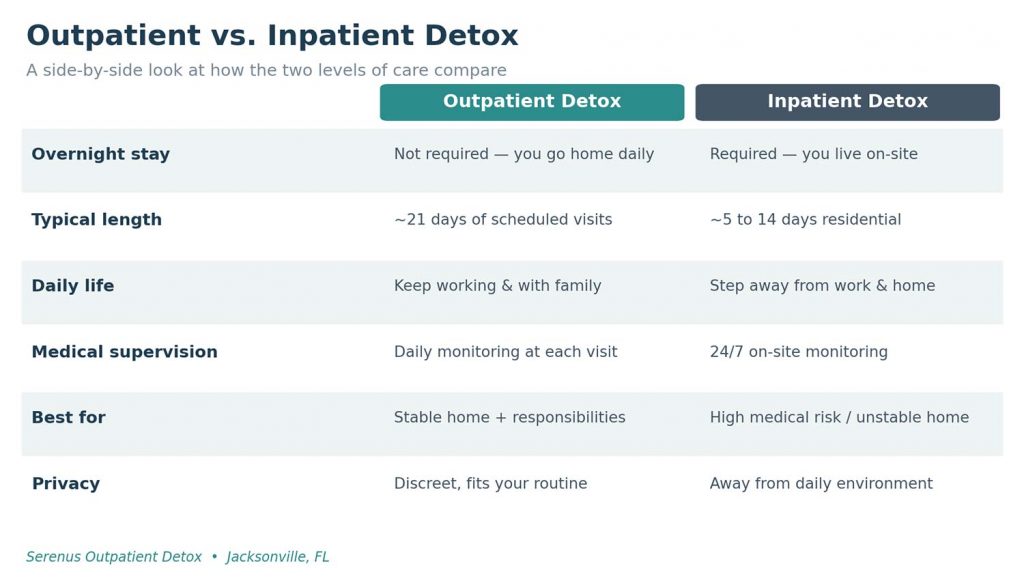
How the two levels of detox care compare at a glance.
Both are medically supervised — that’s not the dividing line
A common myth is that outpatient detox means going it alone. It doesn’t. In a true medical outpatient program, a clinical team takes your vitals, tracks your withdrawal symptoms, and adjusts your medications at every visit. The difference isn’t whether you’re supervised — it’s how often, and whether that supervision happens around the clock.
When Inpatient Detox Makes Sense
Inpatient care exists for good reasons, and for some people it’s the safest first step. It’s typically the right call when withdrawal carries serious medical risk, when there have been complications like seizures in the past, when there’s no stable or sober place to go home to, or when someone needs to be fully removed from their environment to get through the first stretch safely.
If that describes your situation, 24/7 monitoring isn’t a luxury — it’s the appropriate level of care. The goal is always safety first.
REAL TALK The “best” program isn’t the most intensive one on paper — it’s the one a person will actually start and finish. A plan that ignores someone’s job, kids, or rent is a plan they’re more likely to walk away from. Fit drives follow-through.
When Outpatient Detox Is the Right Call
For a large share of people, outpatient detox is a clinically sound choice that doesn’t force an impossible trade-off between getting help and keeping a life. Picture a nurse with two kids and a mortgage who knows she needs to stop drinking but can’t vanish for two weeks without her whole world noticing. Outpatient care is built for exactly that person.
You can keep working. You can sleep in your own bed. You can stay close to your support system instead of leaving it behind. And you still get real medical oversight every single day. To see how a full clinical model works in practice, our medically supervised outpatient detox program pairs daily nursing checks with peer support and counseling — not just a prescription and a wave goodbye.
There’s also a practical side worth naming: cost and coverage. Because outpatient detox doesn’t include room and board, it’s often more affordable than a residential stay, and many insurance plans cover medically supervised outpatient care. That matters when someone is already worried about missing a paycheck. A program that verifies your benefits up front takes one more unknown off the table before you commit.
Who outpatient detox tends to fit well
Outpatient detox works well for people who have a stable home and a support system, who need to keep up with work or family responsibilities, who are motivated to show up for a structured daily program, and whose withdrawal can be safely managed without an overnight stay. Alcohol, opioids, benzodiazepines, stimulants, and prescription medications can all be addressed this way when a medical evaluation confirms it’s appropriate.
The Question Most People Forget to Ask
Detox isn’t actually a two-option menu. It’s a continuum of care, from the most flexible setting to the most intensive. Understanding where each option sits helps the choice make a lot more sense — and it explains why “outpatient” and “inpatient” aren’t really opposites so much as two points on the same line.
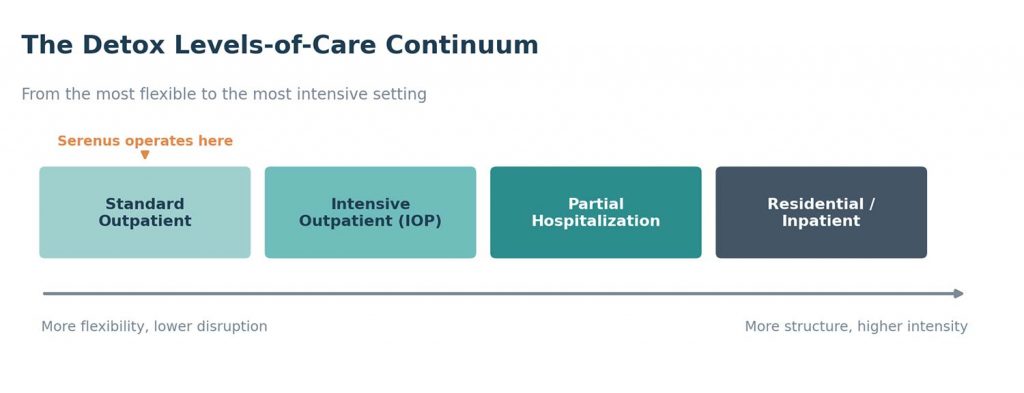
Detox care runs along a continuum — the right spot depends on medical need.
This is also why the question to ask isn’t just “inpatient or outpatient?” It’s “which level of care matches my medical need and my life right now?” Sometimes the answer even changes over time — someone might step down from a higher level of care into outpatient support as they stabilize.
How to Decide: A Simple Way to Think It Through
You don’t have to figure this out alone, and you shouldn’t try to self-diagnose your withdrawal risk. But you can get a strong sense of direction by working through a few honest questions before you ever pick up the phone.
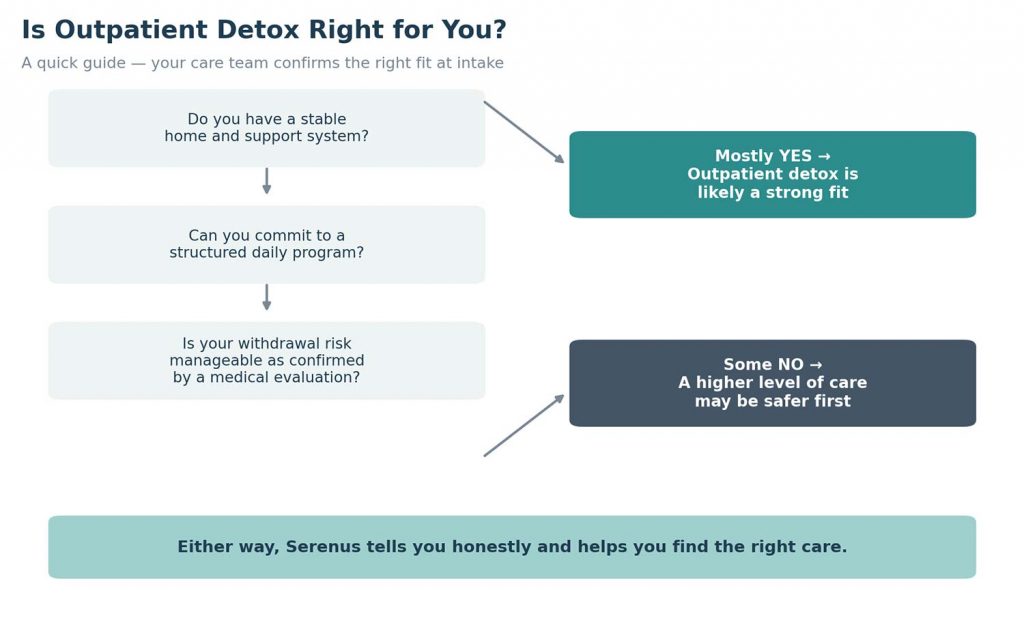
A quick gut-check — your care team confirms the right fit during a full evaluation.
As a leader in medically supervised outpatient detox in Jacksonville, Serenus Outpatient Detox built its program around a simple promise: the same level of medical oversight you’d expect from a residential setting, delivered on a schedule that respects your real life. And if an evaluation shows a higher level of care is safer, the team says so and helps you find it. You can see what the admissions process looks like before committing to anything.
FROM THE INTAKE ROOM Before you call any program, jot down three things: the substances involved and roughly how much per day, any past withdrawal complications (seizures, DTs, hospital visits), and your insurance card. Those answers let a clinical team tell you — quickly and honestly — whether outpatient detox is safe for you.
Choosing the Path That Fits Your Life
Inpatient and outpatient detox aren’t a contest with a single winner. The right choice comes down to your medical needs, your home environment, and the life you’re trying to protect while you heal. For many working adults with a stable foundation, outpatient detox offers a safe, supervised way forward without putting everything on hold.
If you’re not sure where you land, that’s exactly what an evaluation is for. Talk with the Serenus care team — they’ll verify your insurance, answer your questions, and help you find the right level of care, no pressure attached.
Ready to find out if outpatient detox is right for you? Call Serenus: 904-890-1442
FAQs
The best way to choose outpatient detox versus inpatient is a professional medical evaluation, not a self-assessment. A clinical team weighs your substance use history, withdrawal risk, home stability, and responsibilities to recommend the safest fit. Many people with a stable home and manageable withdrawal are strong candidates for outpatient care.
Yes. Detox is a continuum, and stepping down is common. Someone may begin with more intensive care to get through the riskiest early days, then transition to outpatient detox to finish safely while easing back into daily life. A good program plans that transition with you rather than leaving you to navigate it alone.